
Lately, I have found myself reflecting on an African proverb: “If you want to go fast, go alone. If you want to go far, go together.” Perhaps more now than any time in Friends of the Eel River’s 30-year history, it’s important to keep this understanding in focus. We are stronger together.
With your support, Friends of the Eel River has grown over the last year in exciting and hopeful ways. After several years of careful planning, we’ve just launched two new programs. Both programs rely on relationships with many partners.
We launched the Eel River Native Plant Network this March with a virtual orientation. As I write this letter, we are preparing for the first in-person meeting in Fortuna on June 18. The Network seeks to connect Tribal Nations, stewards, restorationists, gatherers, and growers to sustain and increase regionally diverse native plant material production that supports Eel River watershed cultural and ecosystem restoration.
Through about two dozen one-on-one interviews over the last two years, we’ve learned what people are prioritizing in their work with native plants: preserving local genetics, collecting and amplifying culturally significant species, and managing for invasive species. We have begun exploring barriers to regional capacity growth, such as a lack of infrastructure to support native seed production, limited access to collection sites, and workforce gaps. And we are starting to identify specific projects the network could complete. These include things like investing in shared infrastructure, building a new nursery in the Eel basin, building a seed availability database, and supporting workforce development. Please connect with us at nativeplantnetwork@eelriver.org if you want to get involved in this generational project.
The second new program we’ve just launched is the Eel River Capacity Building and Road Improvement Planning Project. This project spans the entire basin, with four focus regions in the Van Duzen, South Fork, Mainstem, and Middle Fork. Big picture – this project will ultimately reduce road-related sediment delivery to the Eel River. The project includes training opportunities for Tribal staff, nonprofits, and members of road associations. Working with partners throughout the watershed, we will conduct community outreach to assist in establishing road associations, complete road assessments, and plan dozens of shovel-ready projects to reduce sediment pollution and improve safety and reliability of local road networks. Stay tuned as we get this project off the ground!
But of course, in the midst of launching these new programs, a new twist has emerged in our efforts to undam the Eel. As you probably recall, PG&E submitted their final license surrender application last summer. When the Federal Energy Regulatory Commission held a public comment period we saw over 600 people voice their support for dam removal. Thank you for speaking up and showing a united front.
Meanwhile, a coalition of entities in both the Eel and Russian Rivers have spent years negotiating a deal to support dam removal and allow continued diversions from the Eel to the Russian during the wet season. This deal, commonly referred to as the Two Basin Solution, also takes a significant step toward righting historical injustice, transferring PG&E’s senior water right to the Round Valley Indian Tribes. This is the best option for expedited dam removal and local control of water resources.
The saga of Eel River dam removal already includes many dizzying twists. PG&E’s initial plans for relicensing shifted to decommissioning amidst the utility’s 2019 bankruptcy filing. A transformer failed in 2021, curtailing electrical generation. A still semi-secret seismic stability study of Scott Dam required swift and permanent mitigations, reducing reservoir capacity by 20%.
But the biggest twist yet came this spring when USDA Secretary Brooke Rollins announced there was a buyer lined up to take over the Potter Valley Project. While that announcement turned out to be a bit of a hyperbole (there is no offer yet, or formal movement in that direction), there is in fact interest from at least two water districts in Southern California. One board member from Elsinore Valley Municipal Water District has been quite clear – they don’t want the power, they don’t want the water (yet), they just want to profit off of Russian River water users.
This is a rapidly evolving situation and we need your support to show a united front. Please click here to see the latest advice for taking action against this water grab. If you can’t join us to take action, consider supporting our staff to do so. A $50 donation covers roughly one hour of staff time to call into meetings and stand up for the Eel. A $300 donation would cover a flight to Los Angeles for one staff person to attend a meeting in person.
We know that there is power in the strength of our relationships and collaboration on shared goals. That’s why we’re working with local and state-wide partners and Tribal Nations to stand up to the intimidation and threats. You too are a part of what makes a small grassroots organization like Friends of the Eel River mighty. Thanks for your support now and into the future!
For the fish and all of us,
Alicia Hamann
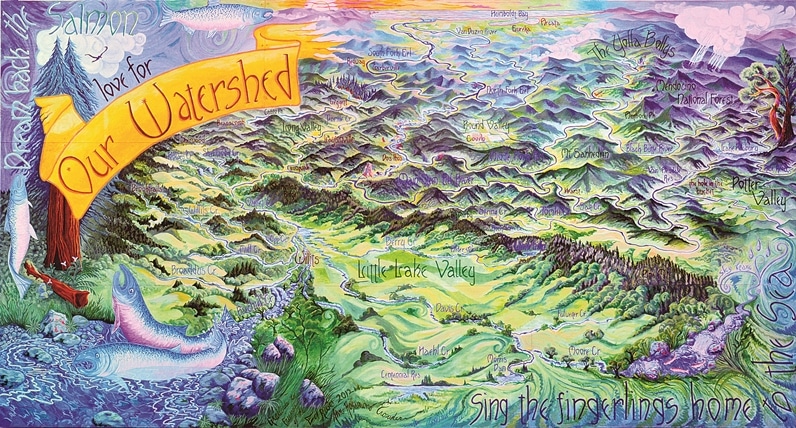
The Eel Watershed mural in Willits at the corner of Main and East Valley streets.
Executive Director
PS – we’re also working with local artist Rosamond Crowder to restore the Willits Mural. Click here to direct a donation toward supporting that project.