
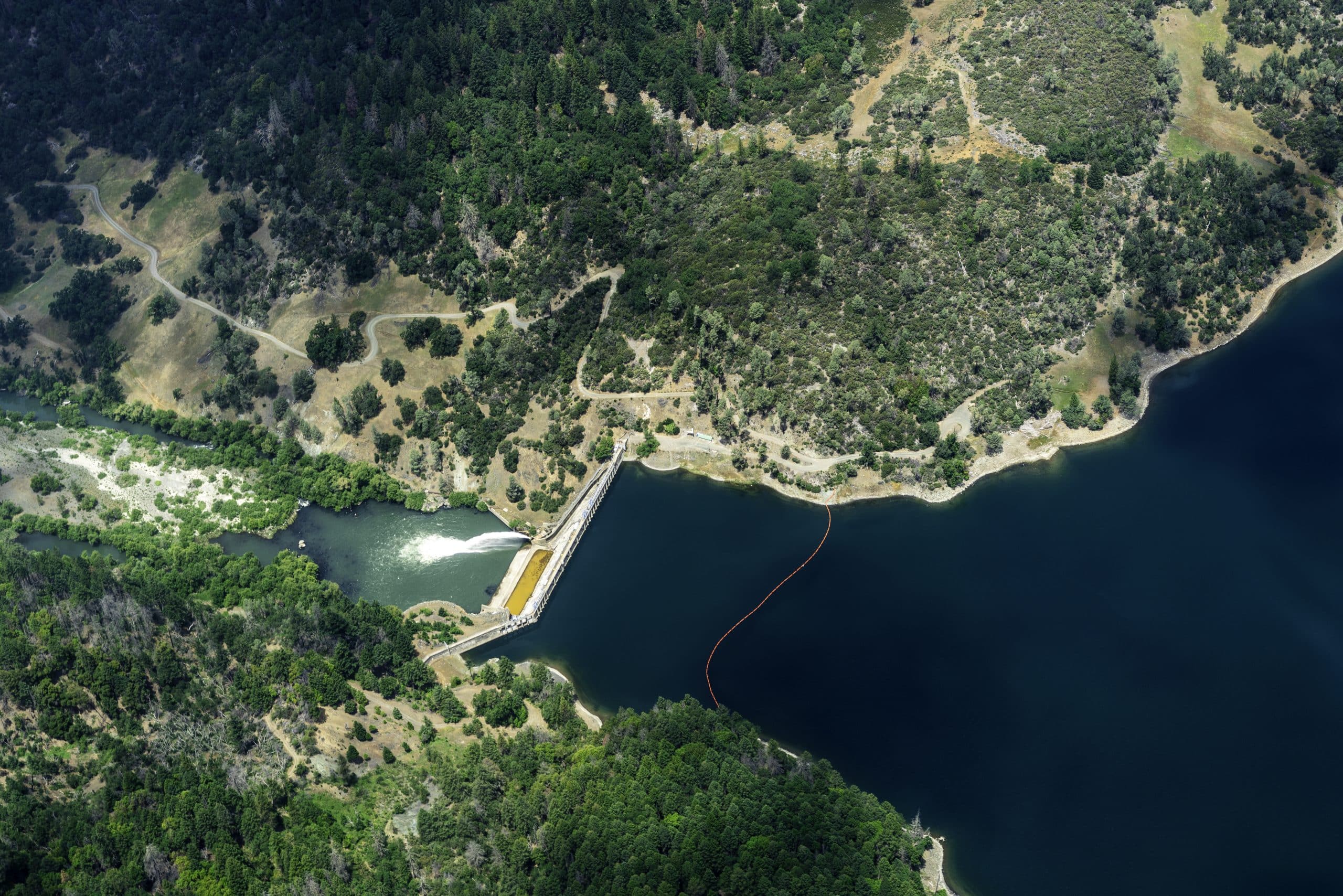
Scott Dam impounds Lake Pillsbury. Photo by EcoFlight.
Recent news about a Southern California water agency interested in taking over the Potter Valley Project has many of us distracted, but not the Federal Energy Regulatory Commission (FERC).
FERC is responsible for overseeing hydropower projects, and approving their decommissioning. As such, FERC has just announced the next step toward dam removal with the commencement of their National Environmental Protection Act (NEPA) process to analyze the impacts of Eel River dam removal.
A comment period is currently open until September 18th to receive comments on FERC’s Scoping Document.
Two meetings are scheduled for Tuesday, September 15th from 6-8pm and Wednesday, September 16th from 9-11am at the Wharfinger Building (1 Marina Way) in Eureka, CA. Instead of giving comments in front of the whole room, attendees will be given numbered tickets and called in order to provide oral comments to a stenographer. These comments will later be published as part of the public record. For more information, see FERC’s notice of additional scoping sessions.
What Is the Scoping Document?
The Scoping Document outlines what FERC will evaluate in their NEPA process, and clearly affirms that the only path forward for this project is dam removal.
FERC has rejected the possibility of retaining Scott Dam, citing seismic stability concerns and economic losses of the project. The option of a Federal Government takeover has also been rejected, as FERC says that no federal agency has expressed interest in operating the project. Finally, FERC has also removed analysis of dam removal without building the New Eel-Russian Facility (NERF), the proposed diversion infrastructure that will facilitate wet-season diversions following dam removal.
This last alternative removal has us concerned. If something goes wrong and the Eel-Russian Project Authority is unable to begin construction of the NERF facilities when PG&E is ready to remove the dams, FERC may need to issue a supplemental Environmental Impact Statement, which could delay dam removal. The endangered and threatened species of the Eel River cannot afford to wait.
Talking Points
- I support the timely initiation of this NEPA process.
- The Scoping Document states that keeping the dams is not an option, I agree.
- To reap the benefits of ecosystem restoration, dam removal must be authorized in a timely manner.
- PG&E’s application for dam removal includes a collaborative solution for continued water supply for the Russian River that is also protective of habitat in the Eel River.
- There should be a “no NERF alternative” in the analysis so that dam removal is not delayed by any issues with construction of the New Eel-Russian Facility (NERF). That is a core principle in the collaborative agreement for continued water diversions after the dams are removed.
- Dam removal will benefit cultural revitalization and the economies of downstream communities. A single wild salmon is worth more than a barrel of oil, and has immeasurable value to Indigenous people.
- Include any additional information you have about the benefits or impacts of dam removal, such as:
- The need for further studies and mitigations to avoid impacts on aquatic life during release of sediment.
- Conditions for preventing further spread of invasive Sacramento pikeminnow.
- Incorporating native or culturally relevant plants into revegetation plans.
The most important message you can send to FERC is that you support their timely initiation of the NEPA process, and that you agree with their Scoping Document that keeping the dams is not an option.
While we support continued wet-season diversions following dam removal, allowing the NERF to delay dam removal in any way is unacceptable. So we also recommend telling FERC that they should include a “no NERF alternative” in their NEPA analysis.
FERC also needs to understand that dam removal will benefit cultural revitalization and the economies of downstream communities. A single wild salmon is worth more than a barrel of oil, and has immeasurable value to Indigenous people. Returning wild salmon runs to abundance will have a ripple effect throughout North Coast communities.
Finally, any comments made on PG&E’s License Surrender Application at the end of 2025 will be included in FERC’s Scoping process. So you do not need to reiterate any detailed or technical comments made during that comment period. However, any additional information you have about the benefits or impacts of dam removal should be included in your comments. For example, emphasizing the need to study and avoid impacts on aquatic life during the release of sediment, evaluating options for preventing further spread of invasive pikeminnow, or incorporating particular native plants into revegetation plans following dam removal.
How to Comment Electronically or by Mail
If you cannot attend the meetings in Eureka, you can still submit comments by September 18th. Comments must be clearly labeled “Potter Valley Project (P-77-332)”.
Electronic Comments
- Navigate to FERC Online, click on eComment, and follow on screen instructions.
- Check your email for your eComment link.
- Draft your comments in a Word or text file, so you can copy and paste them into the text box on FERC Online.
- Search for docket number (P-77-332) and select the blue + symbol
- Enter your comments in the text box, and select “Send Comment”.
Snail Mail Comments
Debbie-Anne A. Reese, Secretary,
Federal Energy Regulatory Commission
888 First Street NE, Room 1A
Washington, DC 20426